
56 of 234 Hyperliquid Perps Traded Zero Today. Here Is What Is Actually Liquid.
A per-asset liquidity audit of Hyperliquid perps. 56 markets had zero 24h volume. The top 5 hold 80% of volume. Median nonzero volume is $463K. This is the map of which perps are tradeable and which are listed but dead.
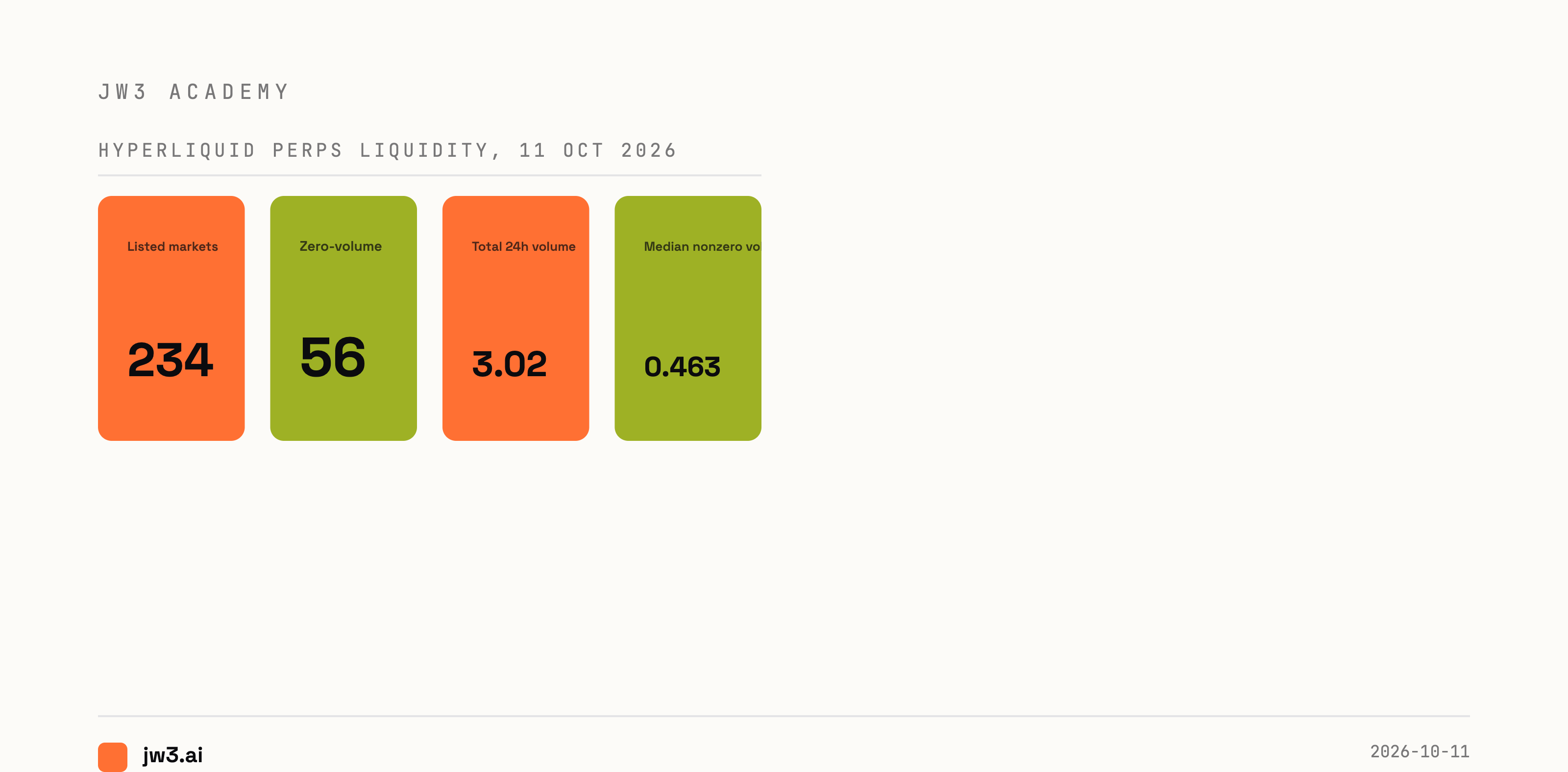
On 11 October 2026, the Hyperliquid perpetuals venue listed 234 markets. According to the Hyperliquid API, 56 of them traded zero in the past 24 hours. Another 178 traded something, but half of those did less than $463,036. The venue is deep at the top and thin everywhere else.
This article is a liquidity audit. It breaks down which Hyperliquid perps have real volume, which are listed but illiquid, and what that means for anyone choosing a market to trade.
The concentration #
Total 24h notional volume across all 234 perps was $3.02 billion. ETH and BTC together accounted for 62.3% of it. ETH traded $1.03 billion. BTC traded $843 million. The top 5 assets, ETH, BTC, HYPE, NEAR, and STRK, held 80.2% of all volume. The top 10 held 88.9%.
The remaining 224 markets split 11.1% of the venue's volume. That averages to $13.5 million per market, but the average hides the real distribution. The median nonzero volume was $463,036. Half of the markets that traded at all did less than half a million dollars in 24 hours.
A $500,000 market order on a market with $463K in daily volume is larger than a day's trading. It will move the price. The Castle Labs study of live order books across 10 venues, published 1 October 2026, measured Hyperliquid's resting depth within 10 bps of the mid at $54.5 million on BTC. On Solana, it held $4.7 million. On smaller assets, the depth drops further.
The zero-volume markets #
56 markets had zero volume in 24h. That is 24% of all listed perps. They are not delisted. They are still tradable in the sense that the order book exists and orders can be placed. But with no recent trades, there is no meaningful price discovery. The last trade could have been days or weeks ago. A market order on a zero-volume market would execute against whatever resting orders exist, at whatever price they are, with no recent trades to anchor the fair value.
Zero-volume markets are not a Hyperliquid problem. They are a structural property of any venue that lists many assets. The venue lists a market because there is demand or expected demand. Some of those markets attract traders. Most do not. The listing is cheap. The liquidity is not.
The volume ladder #
The top 10 markets by 24h volume on 11 October 2026 were:
| Rank | Asset | 24h Volume | Open Interest | Funding |
|---|---|---|---|---|
| 1 | ETH | $1.033B | 1.12M | -0.00065% |
| 2 | BTC | $843.0M | 38.1K | -0.00052% |
| 3 | HYPE | $222.7M | 20.0M | +0.00125% |
| 4 | NEAR | $177.1M | 74.4M | +0.00125% |
| 5 | STRK | $147.3M | 510.7M | +0.00125% |
| 6 | ZEC | $78.7M | 463.5K | +0.00125% |
| 7 | SOL | $70.2M | 5.73M | +0.00125% |
| 8 | PUMP | $54.6M | $39.65B | +0.00125% |
| 9 | WLD | $33.4M | 152.4M | +0.00125% |
| 10 | SUI | $27.3M | 62.4M | +0.00125% |
The ladder drops sharply after the top 2. ETH and BTC are in a tier of their own. HYPE at number 3 is one-fifth of ETH's volume. By rank 10, volume is down to $27.3 million, a thirty-eighth of ETH.
The open interest divergence #
Open interest tells a different story. The top 5 by open interest were PUMP at $39.65 billion, HMSTR at $8.92 billion, kPEPE at $6.83 billion, BOME at $4.18 billion, and kBONK at $2.58 billion. These are memecoins. Their combined open interest is $62.2 billion, 79.3% of the venue's total $78.36 billion.
But their volume tells the real story. PUMP traded $54.6 million in 24h, a 0.14% turnover of its open interest. HMSTR traded $17,919. kPEPE traded $1.6 million. BOME traded $244,617. These positions are held, not traded. The open interest is real capital at risk, but it is not generating price discovery.
The divergence between volume and open interest is the defining feature of the Hyperliquid perps market. Capital concentrates in memecoins for leverage exposure. Trading concentrates in majors for price discovery.
What liquidity means for execution #
Liquidity determines execution quality. On a deep market like ETH, a $100,000 market order is a fraction of a percent of 24h volume. It will fill near the mid price with minimal slippage. On a thin market, the same order is a significant portion of the day's volume and will move the price.
The Castle Labs study measured this directly. On a $100,000 BTC order, Hyperliquid's slippage was 0.21 bps against a centralized median of 0.07 bps. Adding the taker fee, Hyperliquid was 4.71 bps all-in against 5.07 bps on the centralized median. Hyperliquid was 7% to 24% cheaper than the centralized median on BTC, ZEC, and HYPE.
But those measurements are for deep markets. On smaller assets, Hyperliquid's depth is thinner. The study found that resting size within 10 bps on Solana was $4.7 million, a fraction of the $54.5 million on BTC. On pre-IPO perps, no venue held more than $160,000 within 10 bps.
The funding signal #
Funding rates on the most liquid markets were near zero. ETH funding was -0.00065% per hour. BTC was -0.00052%. These are balanced markets. Longs and shorts are roughly equal, so the funding transfer is small.
The most negative funding rate on the venue was MINA at -0.0563% per hour, with $21.3 million in open interest. That is a crowded short. The most positive was PAXG at +0.00125% per hour, with $5,651 in open interest. The divergence between majors and alts is stark. Majors are balanced. Alts are crowded on one side.
How to use this data #
First, check volume before you open a position. The Hyperliquid API is open and free. The metaAndAssetCtxs endpoint returns 24h volume, open interest, and funding for every asset. A market with less than $1 million in daily volume is a market where your order will move the price.
Second, understand the difference between listed and liquid. A market can be listed and still be illiquid. The listing means the order book exists. It does not mean there is depth. Zero-volume markets are the extreme case, but markets with $100,000 in daily volume are also thin.
Third, respect the leverage tier. Hyperliquid caps leverage by asset. BTC allows 40x. ETH allows 25x. Smaller assets allow less. The cap is the venue's assessment of how volatile the asset is. Trading at the maximum leverage on a volatile asset is a fast way to liquidation.
Fourth, use JW3.ai to see this data alongside price and volume in one interface. The app integrates the Hyperliquid API so you can check liquidity before you trade.
The structural picture #
Hyperliquid's perps market is two markets. One is a deep, efficient market for majors where execution quality rivals centralized exchanges. The other is a long tail of listed-but-illiquid markets where open interest concentrates in memecoins and price discovery is minimal.
Neither is a bug. The venue lists markets because there is demand. The market decides which ones trade. The result is a concentration of volume in a few majors and a concentration of open interest in a few memecoins.
Understanding this split is essential for trading perps on Hyperliquid. The majors are for trading. The memecoins are for holding leveraged exposure. The zero-volume markets are for neither.
Cryptocurrency trading, leveraged perpetual futures, and automated algorithmic strategies carry significant risk of rapid and total financial loss. Never risk funds you cannot afford to lose completely.