
234 perps, five markets
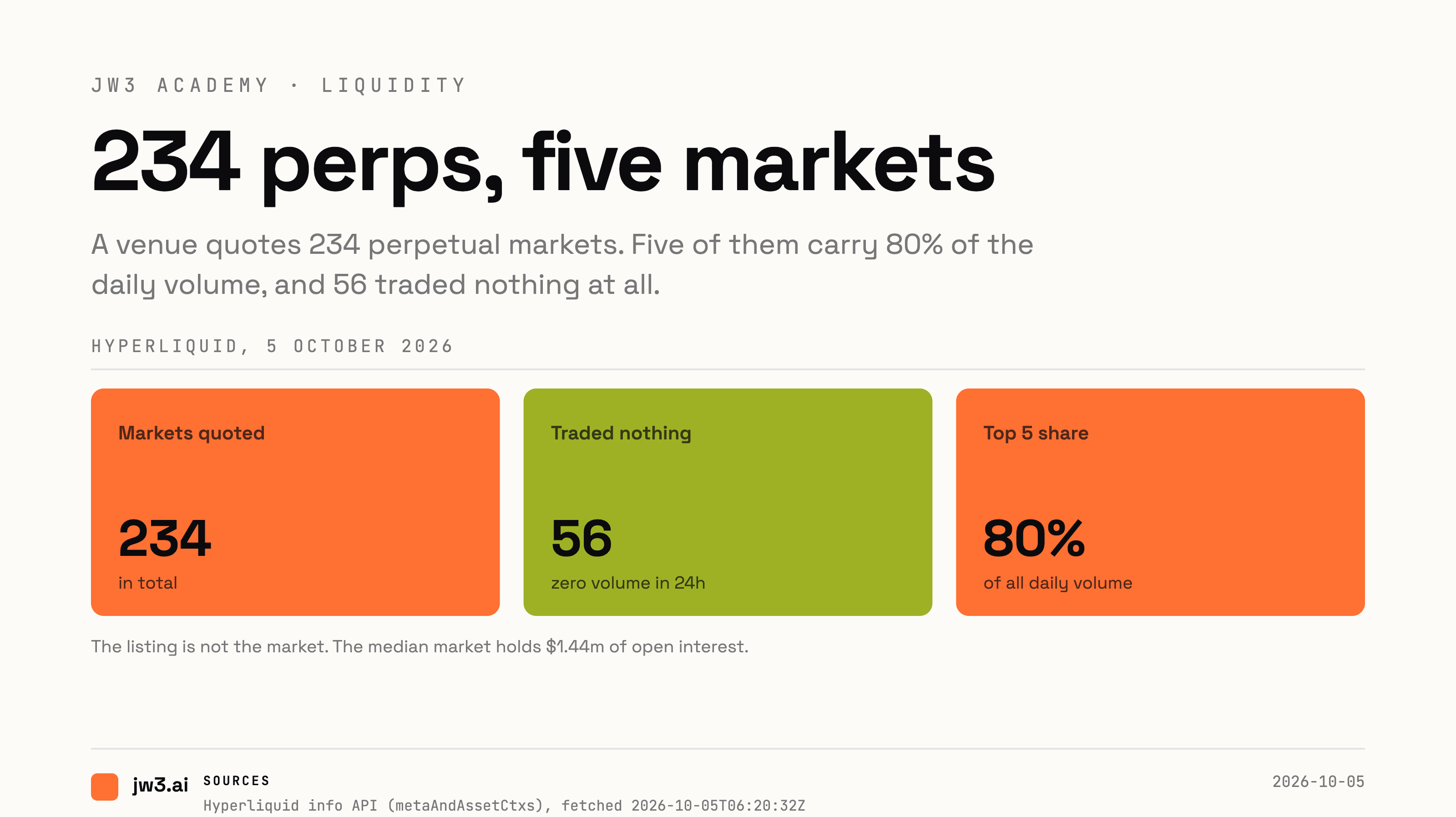
Hyperliquid quotes 234 perpetual markets. Five of them carry 80.0% of the daily volume. 56 traded not one dollar in a day. What the distribution of a venue's own listings says about how much of it is actually tradeable.
Aún no está en tu idioma — mostrando inglés.
Counting how many markets a venue lists feels like measuring it. A hundred and thirty-four tickers feels like depth. It is not a measurement of anything.
Here is the distribution from Hyperliquid's own API at 06:20 UTC on 5 October 2026.
| Measure | Value | |---|---| | Markets quoted | 234 | | 24h perp notional volume | $4.13bn | | Open interest | $13.24bn | | Top 5 share of 24h volume | 80.0% | | Top 5 share of open interest | 73.2% | | Top 10 share of open interest | 83.4% | | Markets that traded zero volume in 24h | 56 | | Markets with under $1m of open interest | 108 | | Median market open interest | $1.44m |
Two thirds of the venue exists as a listing. Four fifths of the trading happens in five of them.
The listing is not the market
56 of 234 markets traded nothing at all in a full day. Not thin. Nothing. They are quoted, they accept orders, and no one traded them.
That is not a rounding error, and it is not a criticism of the venue. A listed market costs almost nothing to create, so the count mostly measures how cheap listing is. What a trader needs is the opposite number: how much capital is actually resting in each market.
108 markets hold under $1m of open interest. 69 more sit between $1m and $10m. So 177 of 234 markets have less than $10m resting on them.
The median market holds $1.44m.
Why that number matters more than it looks
Open interest is the total value of open positions. It is the capital at risk in a market, and it is a decent proxy for how much a market can absorb before it becomes a queue.
A single large liquidation can be a meaningful fraction of a thin market's open interest. When that happens the position cannot be closed against the book, so it fills somewhere worse, and the loss compounds. The mechanism is not exotic; it is what happens in any book with less depth than the order.
So the practical version of the table above: on this venue, the median market has enough capital to be moved by a handful of accounts. Whether that matters to you depends entirely on your size relative to that market's open interest, not the venue's total.
Where the capital actually is
| Market | Mark | 24h volume | Open interest | |---|---|---|---| | BTC | $85,914 | $1.86bn | $3.26bn | | ETH | $2,712 | $791m | $3.30bn | | HYPE | $91.329 | $264m | $1.86bn | | ZEC | $1,323 | $217m | $614m | | NEAR | $4.9669 | $168m | $352m |
BTC and ETH open interest are within a few percent of each other, at roughly $3.26bn and $3.30bn respectively. That is unusual, and it is worth noting: the largest concentration of capital on the venue is not in one asset.
How to run this check on any venue
The audit is one request. Most venue APIs return the universe and the per-market context together:
curl -s -X POST https://api.hyperliquid.xyz/info \
  -H 'Content-Type: application/json' \
  -d '{"type":"metaAndAssetCtxs"}'
Then compute four things: how many markets have zero volume, how many hold under $1m of open interest, what share of volume the top five carry, and what the median market holds. That is the venue's real shape. The listing count is not.
The honest caveat
This is one venue at one moment. Two things would change the picture and neither is hidden:
- New listings start at zero. A market listed last week is not broken, it is new. The
56 empty markets include legitimate day-old listings.
- Open interest is not liquidity. It is capital committed, not depth at every price
level. A market can hold real open interest and still gap, because the resting orders are concentrated at one price.
So the honest claim is narrower than "most of this venue is unusable". It is that listing count is not a measure of depth, and the distribution is one request away.
What to do with it
Before you take a position in a market you have not traded, find its open interest and compare it to your size. If your order is a visible fraction of it, you are not trading, you are queueing.
If that check is inconvenient, the position you wanted is almost certainly in the five markets that carry the volume anyway.
Sources
Every figure in this piece comes from one request:
- Hyperliquid info API, request body
{"type":"metaAndAssetCtxs"}, fetched 2026-10-05T06:20:32Z: the 234-market universe, per-market mark price, open interest, 24-hour volume and funding.
Volume and open interest move continuously. The counts of empty and thin markets are a snapshot; the method is the part that keeps.
Cryptocurrency trading, leveraged perpetual futures, and automated algorithmic strategies carry significant risk of rapid and total financial loss. Never risk funds you cannot afford to lose completely.