
Tokenized stock is not stock ownership
Buying $AAPLx buys a token, not Apple. What tokenized equities actually give you, what they quietly do not, and what the regulators have and have not approved.
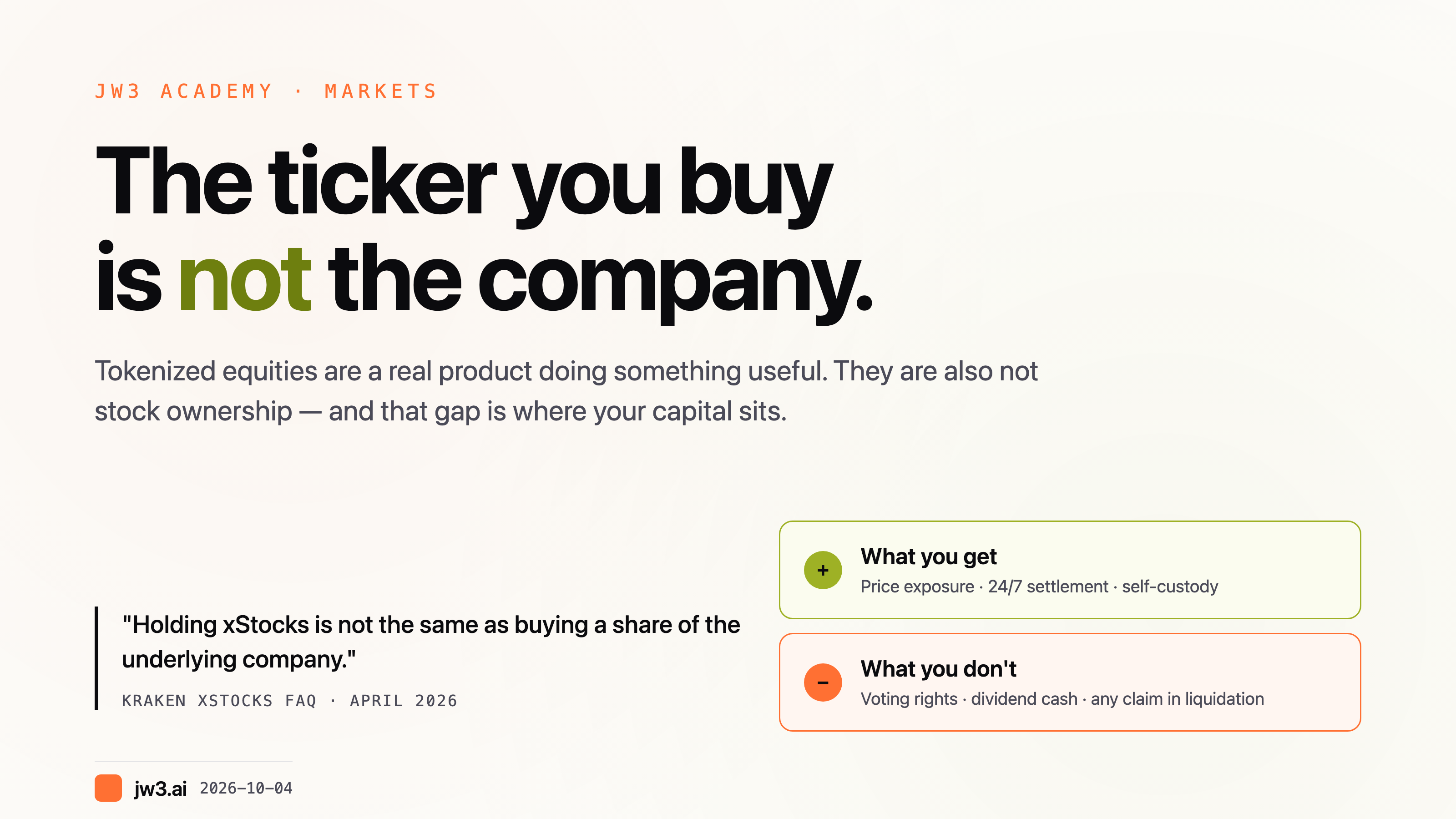
The ticker you buy is not the company you think
Buy a token called $AAPLx and you have bought a token called $AAPLx. You have not bought Apple.
That gap is the entire story of tokenized equities right now, and almost nobody in the marketing material mentions it. Kraken's own support documentation is unusually blunt about it. From the xStocks FAQ, last updated April 2026:
xStocks are tokenized representations of real U.S. stocks and ETFs. Each xStock is backed 1:1 by the underlying equity, held in regulated custody, and issued as an onchain token on Solana, Ethereum, TON, and Ink.
Backed 1:1. Held in regulated custody. Both true. And then:
Holding xStocks is not the same as buying a share of the underlying company. xStocks provide exposure to the value of the stock but do not carry shareholder rights, voting rights, or any legal claim to the underlying company shares or residual assets in the event of the underlying company's liquidation.
Read that twice. If the underlying company liquidates, your token does not entitle you to anything from it. You hold a claim on an issuer, in a jurisdiction, backed by a custodian. The share exists. You are not the shareholder.
Sources for this section: Kraken xStocks FAQ (last updated April 2026) and the Kraken xStocks Risk Disclosure.
What you actually get, and what it costs you
The exposure is real, so let's be precise about what survives.
Dividends come through, but not as cash. Kraken's FAQ describes a rebasing mechanism: the issuer reinvests the dividend by buying more of the underlying, then updates a multiplier. Buy $AAPLx at a multiplier of 1.0, receive a dividend worth a tenth of a share, and the multiplier moves to 1.1. Your balance reads 1.1. You never see a cash credit. There is also a 30% US withholding tax applied before the reinvestment, so the number you receive is already net.
Splits adjust themselves. A 4:1 split multiplies the multiplier by 4 and every holder's balance updates without action.
Trading hours are genuinely different, and this is the strongest argument for the product. The FAQ lists ten assets that trade 24/7 on Kraken Pro: $TSLAx, $QQQx, $SPYx, $NVDAx, $CRCLx, $AAPLx, $HOODx, $MSTRx, $GLDx, $GOOGLx. Everything else trades 24/5 on the exchange, or 24/7 onchain once withdrawn to a self-hosted wallet.
The catch on those 24/7 hours is written in the same document: during regular market hours, prices are anchored to the official exchange price. Outside them, market makers quote from ATS platforms, index futures, and internal models to approximate fair value. Spreads are wider. When the market reopens, divergence is corrected by arbitrage. Kraken's own figure for that correction is historically under 1% mismatch at Monday open. That is their number, not mine, and "historically" is doing real work in that sentence.
The perps layer removes even the custody comfort
Now take the structure and add leverage, and what you have is not a stock exposure at all. It is a derivative on a token that is not a stock.
Ondo announced Ondo Perps in February 2026 as a venue for non-US users to trade perpetual futures on US stocks and ETFs around the clock, with leverage. The innovation Ondo claims is capital efficiency: rather than posting stablecoins as collateral, traders can post their tokenized stock holdings as collateral, even across different assets. Tokenized Tesla collateralizing a Nvidia perp. The collateral problem is real, and the answer is clever.
It is also still a derivative on an instrument that never carried shareholder rights. Leverage did not add rights to the position. It added the risk of losing the capital you posted as collateral.
Source: Ondo Perps announcement (February 3, 2026). Ondo describes the product as available to global non-US users.
Ethena's equity basis trade, announced for Binance on September 25, 2026, makes the structural risk explicit in a way that is worth reading carefully. The hedge leg is short equity perpetuals on Binance. The spot leg is Binance bStocks. Per Ethena's own Risk Committee documentation, until a side letter restricting an issuer's use of backing shares is finalized, that tokenized spot leg represents unsecured credit exposure to a Binance affiliate rather than a claim on the stock.
That is a protocol describing its own hedge leg as unsecured credit exposure. One of the most sophisticated teams in the industry wrote that down about their own trade.
There is a second structural problem, which Ethena also flags: US markets close while the tokenized versions and their perps keep trading. The perp can drift from the underlying off-hours, which weakens the hedge. An asset that trades 24/7 against an underlying that does not is not a rounding error, it is the core risk.
What the regulators have actually done
None of this is settled, and the distinction between announcements and law matters more than usual right now.
In force in the US: the CFTC approved Kalshi's BTCPERP contract as a futures contract on May 29, 2026, under Section 5c(c)(4) and Regulation 40.3. It is cash-settled against the CF Benchmarks Bitcoin Real Time Index. The same release makes a narrow point: the perpetual design may not be suitable for all asset classes. Source: CFTC Release 9240-26.
Not law: Robinhood announced perpetual futures for eligible US customers at HOOD Summit on September 29, 2026, covering BTC, ETH, SOL, XRP, DOGE, ADA, LINK, and HYPE with no expiry, up to 10x on BTC and ETH and 3x on the rest, settling every 15 minutes. Robinhood's own newsroom says "in the coming months." The support page says perps are "rolling out to eligible customers." Nothing is tradeable yet. If you have read that Robinhood launched US perps, that is wrong. Source: Robinhood HOOD Summit 2026.
Also not law: the SEC's Innovation Exemption, effective September 17, 2026, exempts qualifying Tokenized Securities Venues from the Exchange Act definition of an exchange. It is narrow and it is temporary. The venue must be a US person, permissioned, and may only list stocks tokenized by or on behalf of the issuer. Holders must receive the same rights and privileges as the traditional security. Caps are hard: 75 symbols and 0.25% of prior-month average daily share volume for Tier 1 NMS stocks, 250 symbols and 2.5% for Tier 2. The order expires September 17, 2031. The SEC solicited comment and called it a bridge.
In the EU, ESMA responded to the Commission's MiCA review consultation on September 30, 2026, proposing a regulated category for firms that give users access to DeFi protocols, a clearer test for genuine decentralisation, and disclosure obligations on staking, lending, and borrowing. It is a proposal to the Commission. Nothing is enacted. The EBA's position is that tokenised financial instruments should stay outside MiCA entirely and remain under MiFID and MiFIR.
In litigation: CME sued the CFTC on June 18, 2026, arguing perps are swaps rather than futures. The CFTC moved to dismiss on September 2. CME's opposition was due October 2. No ruling as of writing. This case is the tail risk hanging over the entire US onshore perps framework.
The test to apply before you buy any of it
Four questions. If you cannot answer all four, you do not understand the instrument.
Who is the legal issuer of this token? Not the custodian, not the exchange, not the brand you recognise. The issuer. For Kraken xStocks that is Backed Assets (JE) Limited, a Jersey entity.
What rights does the token carry? Price exposure, or shareholder rights? These are different products with different paperwork.
What happens to the hedge when the underlying stops trading? Any 24/7 derivative against a 9:30-to-4 asset carries this gap.
Who holds the backing, and who owes you if they fail? The xStocks structure has a bankruptcy-remoteness design: if Kraken or Backed fails, holders claim underlying value directly with Alpaca Securities. Ask whether your venue documents anything comparable.
The bottom line
Tokenized equities are a real product doing something genuinely useful, and the 24/7 settlement and self-custody properties are not marketing. They solve a real problem.
They are also not stock ownership, and the gap between the two is where your capital sits. Equity perps on top of that gap add leverage to an instrument that never had rights.
Read the risk disclosure. Not the announcement, not the thread, not the token price. The disclosure is where they tell you what it is, and they are required to write it down.
Risk note: cryptocurrency trading, leveraged perpetual futures, and automated algorithmic strategies carry significant risk of rapid and total financial loss. Never risk funds you cannot afford to lose completely. Tokenized securities products described here are offered under the terms of their respective issuers and are generally unavailable to US persons; nothing in this article is investment advice, a recommendation, or an offer to sell any product.