
A recovery funded by tomorrow's fees is not a refund
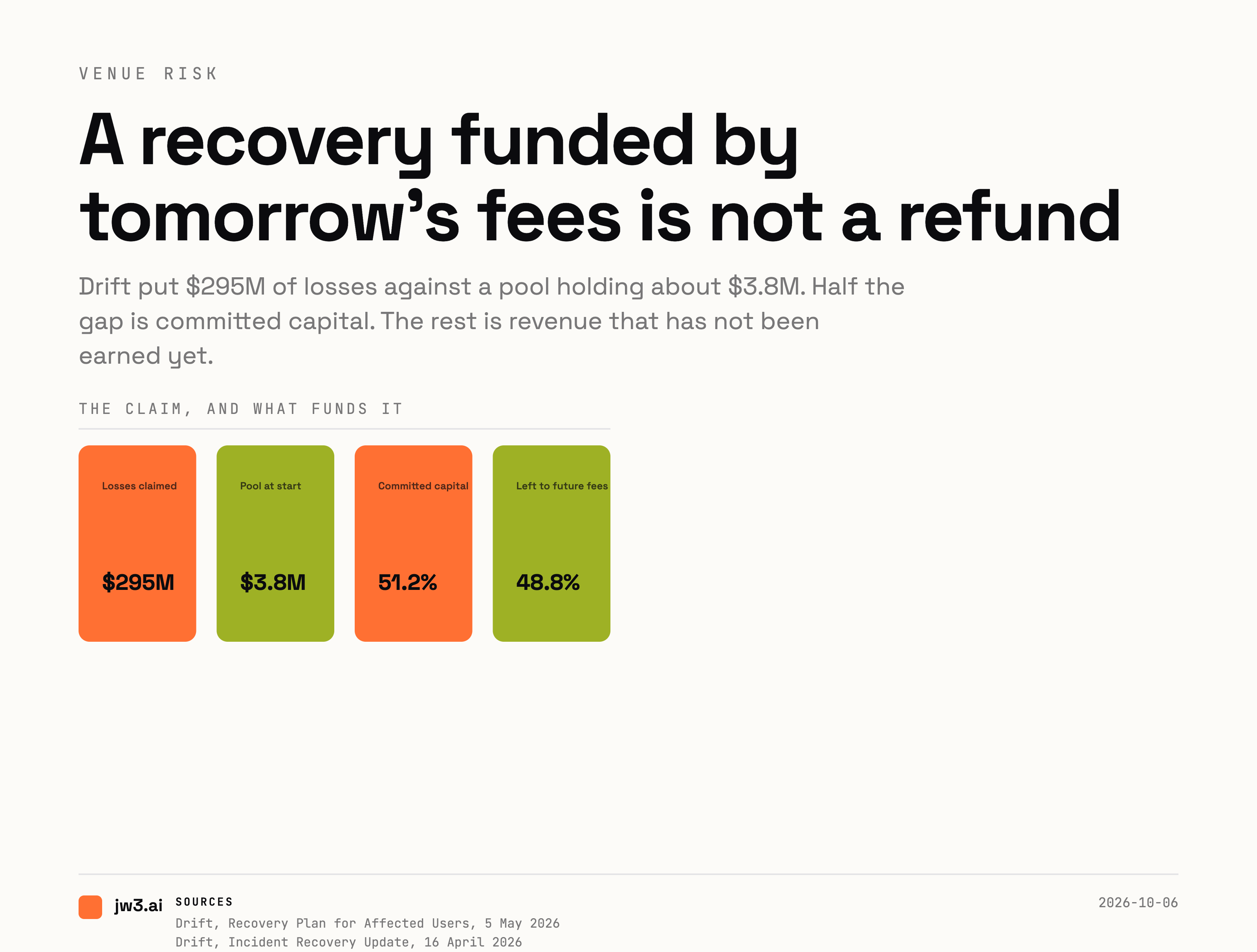
Drift's post-incident updates put $295M of losses against a pool seeded with about $3.8M of remaining assets. Half the shortfall is covered by committed capital. The rest is exchange revenue, which arrives only if trading survives. What a claim on future cash flow is worth, and what it is not.
Cryptocurrency trading, leveraged perpetual futures, and automated algorithmic strategies carry significant risk of rapid and total financial loss. Never risk funds you cannot afford to lose completely.
On 1 April 2026 a Solana perpetual exchange lost $295 million of user deposits, and the interesting part was not the theft. It was the invoice that followed. The recovery structure Drift published puts a number against the loss and a much smaller set of numbers against what will actually pay it. Reading the two side by side is the most useful thing you can do with the event, because it tells you what a claim on a failed venue is really worth.
The root cause matters for one reason and I will keep it to a paragraph: it was not a bug in the protocol. Drift's own recovery plan of 5 May 2026 describes "a sophisticated operation orchestrated by a DPRK-affiliated threat actor, as confirmed by forensic firm Mandiant," and the loss as "the loss of $295M in user funds." The code held. The keys did not.
The invoice
Drift's incident recovery update of 16 April 2026 tabulates what left the protocol. Nineteen assets, totalling $295,706,374.93. The largest line is a single tokenised position at $159,329,898.68, then $71,415,648.65 of one stablecoin and $11,321,165.24 of another. A venue does not get taken out in a uniform proportion. One position class was most of it.
Three weeks later the recovery plan states the pool has to reach "total exploit losses of $295,426,725.97". That is $279,648.96 less than the April table. Both figures come from Drift, both are current on their own publication date, and the gap is the pool maturing against the earlier audited number rather than a new estimate. It is a small discrepancy against a very large one, and it is worth noticing only because the entire structure turns on a target that nobody can verify from outside.
What is actually committed
The pool is described as growing through three capital streams. Only two of them are numbers with a counterparty attached.
| Stream | Amount | What it actually is | |---|---|---| | Remaining protocol assets | about $3.8M | Real, but tiny. Drift's own words: "the current notional value of remaining assets is approximately $3.8M," still to be converted to stablecoin. | | Tether, matched deployment | up to $127.5M | Committed, but "deployment will be based on the exchange's prior-quarter revenue." It scales with the thing that broke. | | Additional partners | up to $20M | Proposed, not confirmed, and capped. | | Exchange revenue | the balance | "a substantial portion of the exchange's net revenue flows directly into the recovery pool." No rate, no floor, no deadline. |
Add the three known lines and you get $151.3 million, which is 51.21% of the claim. The other 48.79%, or $144,126,725.97, is revenue that has not been earned yet.
The seed is the number that should stop you. $3.8M against $295M is 1.29%. The pool has to grow 77.7 times from its opening balance before a recovery token is worth a dollar of its face value. Drift says the pool "will continue accruing until total inflows match total exploit losses," and that "once the recovery pool matures, revenue accrual will stop and all outstanding tokens can be redeemed at full par value or more." Every word of that is conditional on the exchange trading well enough to fill it.
The token is the mechanism
Each affected wallet receives a token that "represents $1 of verified loss." Two properties make it a traded price rather than a promise.
It is transferable. Drift's April update says the token "will be transferable," and the claims portal says each token "converts to USDT at the prevailing redemption price, set by the Recovery Fund rate." A claim on future cash flow that changes hands is priced by whoever holds it, on the day it changes hands.
It is not collateral. The recovery plan states plainly that the "Recovery Token is not eligible as collateral on Drift at relaunch." So a holder who needs to sell one to meet a margin call must sell it into the market, at the prevailing rate, on that day. There is no second source of demand and no venue to return to.
There is a claim deadline attached to that. Any token unclaimed after the window closes "is burned, which proportionately increases the redemption value for remaining holders." Burn logic protects the diligent. It does nothing for the person who missed the window, and it introduces a schedule where none of the underlying assets move on one.
The recovery already works, once
The clearest evidence that the structure is real rather than rhetorical is the part nobody talks about. Drift's insurance fund "is unaffected and all Insurance Fund depositors' assets remain intact," and the portal shows the insurance claim window opened 7 Jul 2026 while the recovery-token window opened 1 Oct 2026. Two windows, two populations, different dates. The fund that covers trading bankruptcies was whole. The fund that holds deposits was not.
That distinction is the lesson. Trading losses and custody losses run through different machines, and only one of them is usually insured. A depositor is exposed to the second.
Scale it against your own venue
None of the above is a reason to avoid this venue or any other. It is a reason to know the size of the number you are exposed to, which is cheaper to measure than to discover.
Hyperliquid's public API, read at 05:03:19 UTC on 6 October 2026, quotes 234 perpetual markets carrying $13,383,924,761 of open interest against $5,207,886,733 of 24-hour volume. 56 of those markets traded nothing at all in a full day. That is a large, continuously operating book, and it is also the number you would be trusting a venue with.
Put Drift's loss against it. $295 million is 2.21% of that open interest and 5.67% of a single day's volume. A loss of that size does not require a market to fail. It requires a key.
The reverse framing is the useful one. The largest committed recovery stream, Tether's $127.5M, is a 43.16% share of a $295M claim, and it deploys in proportion to prior quarter revenue. In a quarter where revenue collapses, the matched capital collapses with it, and the recovery that was 51.21% funded on paper falls toward the 1.29% that was actually in the pool on day one.
That is the shape of the risk. It is not that a venue loses your money. It is that a venue that loses your money also loses the ability to earn its way back to you.
What this does not say
Drift published the stolen-asset breakdown, the recovery framework, the audit commitments, the new multisig and the relaunch conditions. That is more disclosure than most venues in this industry have ever produced about anything, and the figures above come from Drift's own posts rather than from an aggregator or a news summary.
What this does not say is that a $3.8M opening balance against a $295M claim makes recovery unlikely. Drift was explicit that the pool accrues, that committed capital scales with revenue, and that a 10% bounty on recovered assets is live with Arkham and Bybit. The mechanism is real. It is also a mechanism, not a receipt.
Cryptocurrency trading, leveraged perpetual futures, and automated algorithmic strategies carry significant risk of rapid and total financial loss. Never risk funds you cannot afford to lose completely.
Sources
- Drift, Incident Recovery Update, 16 April 2026. Stolen-asset table, Tether and partner commitments, insurance fund status.
- Drift, Recovery Plan for Affected Users, 5 May 2026. Pool structure, three capital streams, token terms, claim mechanics, frozen funds.
- Drift, DFX Redemption portal. Claim windows and redemption mechanism.
- Hyperliquid, `POST /info` `metaAndAssetCtxs`. Market count, open interest, volume, zero-volume count. Fetched 2026-10-06T05:03:19Z.