
The leverage cap is also an order-size limit
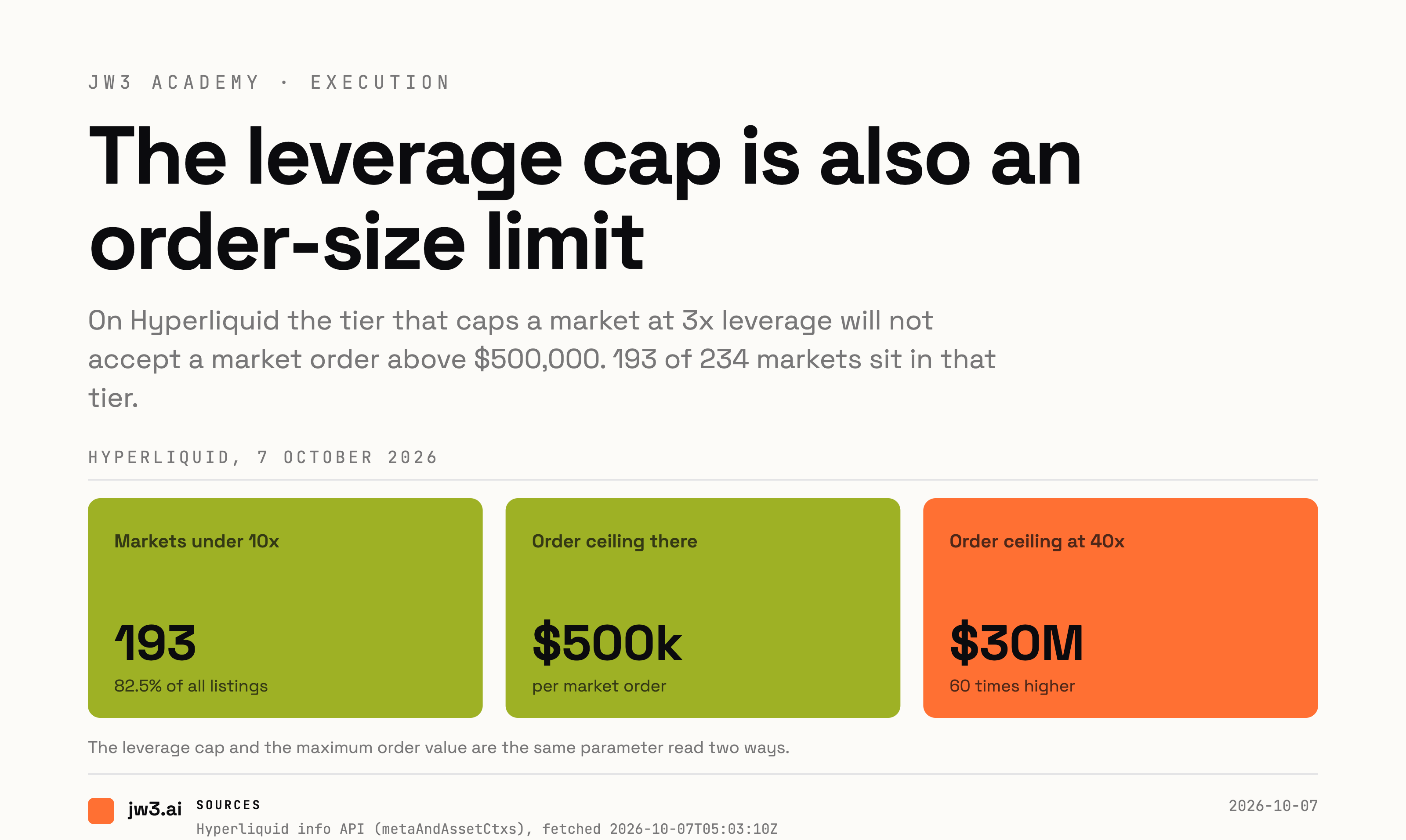
On Hyperliquid a market's leverage cap sets a hard ceiling on the size of a single order, not just on your position. 193 of 234 markets cap at under 10x, and that tier cannot accept a market order above $500,000. What the cap tells you before you size the trade.
Cryptocurrency trading, leveraged perpetual futures, and automated algorithmic strategies carry significant risk of rapid and total financial loss. Never risk funds you cannot afford to lose completely.
A leverage cap reads like a control on your downside. Pick 40x and you can be liquidated by a 2.5% move. Pick 3x and you need a third of the asset's value to disappear. Both statements are true, and both describe the position.
On Hyperliquid the same parameter does a second job that most traders never connect to it. It caps the size of a single order. The venue's contract specifications publish maximum market order value in four tiers, and the tier boundaries are exactly the leverage boundaries. A market that caps leverage at 40x will accept a market order of $30,000,000. A market that caps leverage at 3x will accept $500,000, and not a dollar more.
The largest order a 40x market will take is 60 times the largest order a 3x market will take, and both numbers come from the same field a trader reads to decide how much they can risk.
What the venue actually lists
Here is the distribution across every market the venue quotes, read from its own public POST /info endpoint at 05:03 UTC on 7 October 2026.
| Max leverage | Markets | Share of 24-hour volume | Share of open interest | |---|---|---|---| | 40x | 1 | 44.6% | 26.4% | | 25x | 1 | 18.0% | 23.6% | | 20x | 4 | 5.9% | 7.3% | | 10x | 35 | 25.7% | 33.6% | | 5x | 63 | 4.0% | 6.4% | | 3x | 130 | 1.9% | 2.8% |
Two markets carry a cap at or above 25x, and they are BTC and ETH. Everything else is at 20x or below. The single 40x market is Bitcoin; the single 25x market is Ether.
The volume column is the part that matters. The 41 markets capped at 10x or above hold 94.1% of the venue's $5.51bn in 24-hour volume and 90.8% of its $12.96bn in open interest. The remaining 193 markets, which is 82.5% of everything listed, share 5.9% of the volume and 9.2% of the open interest between them.
The cap is a limit on the order
The tier structure is worth reading closely, because it is not a smooth gradient. It is four steps:
- $30,000,000 for markets with max leverage at or above 25x
- $5,000,000 for markets with max leverage between 20x and 25x
- $2,000,000 for markets with max leverage between 10x and 20x
- $500,000 for everything else
A limit order may be ten times the market order value in the same tier. So a 3x market will accept a resting limit order of $5,000,000 but will not take a $600,000 market order, and the difference between those two numbers is the difference between resting liquidity and taking it.
Put the two tables together and the shape is uncomfortable. A trader who has decided to put $500,000 into a market with a 3x cap has already used the entire market order allowance. There is no partial version of this. Either the order goes through in one print, or it is rejected.
The same rule appears in the liquidations documentation, from the other direction. Maintenance margin is half the maximum initial margin fraction, which the docs state is 1.25% for a 40x asset and 16.7% for a 3x asset. A position in a 3x market is therefore liquidated on a much smaller adverse move than one in a 40x market, and it is also the position whose exit is most likely to arrive as a single large market order.
Why the thin tier is thin
The obvious answer is that the venue is protecting itself, and that is partly right. The less obvious answer is that the cap and the liquidity are the same fact measured twice.
Look at what the 193 thin markets actually trade. The median one turns over $0.50m in a day. The busiest of them, ZRO, did $33.74m. Against a book that size, a $500,000 market order is not a rounding error. It is a meaningful fraction of a day's activity arriving in one instruction.
That is why the order cap and the leverage cap move together. The venue is not assigning a risk appetite to each asset. It is reading the depth of the book and writing the result into two fields: how much leverage the position may carry, and how much size may be sent at once. Both are downstream of the same measurement.
The practical consequence is a screening rule that costs nothing to apply. Before sizing a position, look up the market's max leverage. It tells you the largest single order the venue will accept without a rejection, and it tells you the liquidation distance, from one number. A market capped at 3x is telling you both that it is thin and that it knows it.
What this does not say
None of the above is a criticism of the venue, and none of it is a claim that a 3x market is a bad market. Some of the assets in that tier have real depth in absolute terms. PONS held $48.91m of open interest at the snapshot, and VVV held $68.85m, both on a 3x cap. A cap reflects the venue's read of how much leverage a book can safely carry, and a conservative cap on a volatile asset is a defensible choice.
It is also not a permanent fact. Leverage caps are set per market and can change, and the order-value tiers are documented parameters rather than constants. Read them off the venue, not off an article, including this one. The endpoint is public and returns the whole universe in one request.
What the numbers do support is narrower and more useful. Order size limits and leverage limits are the same limit on this venue, they are published, and they can be read before the trade rather than discovered during it. Most traders check the first and are surprised by the second.
The snapshot matters here. Volume, open interest, and the count of markets in each tier all move. The figures above are a point reading at 05:03 UTC on 7 October 2026, taken from a single API response, and the method is the part that keeps. Pull the same payload yourself and the tier table will have moved; the rule that connects the two columns will not.
JW3 is a non-custodial trading terminal. It routes to venues, it does not hold your keys, and its agent proposes actions that you approve and sign yourself.