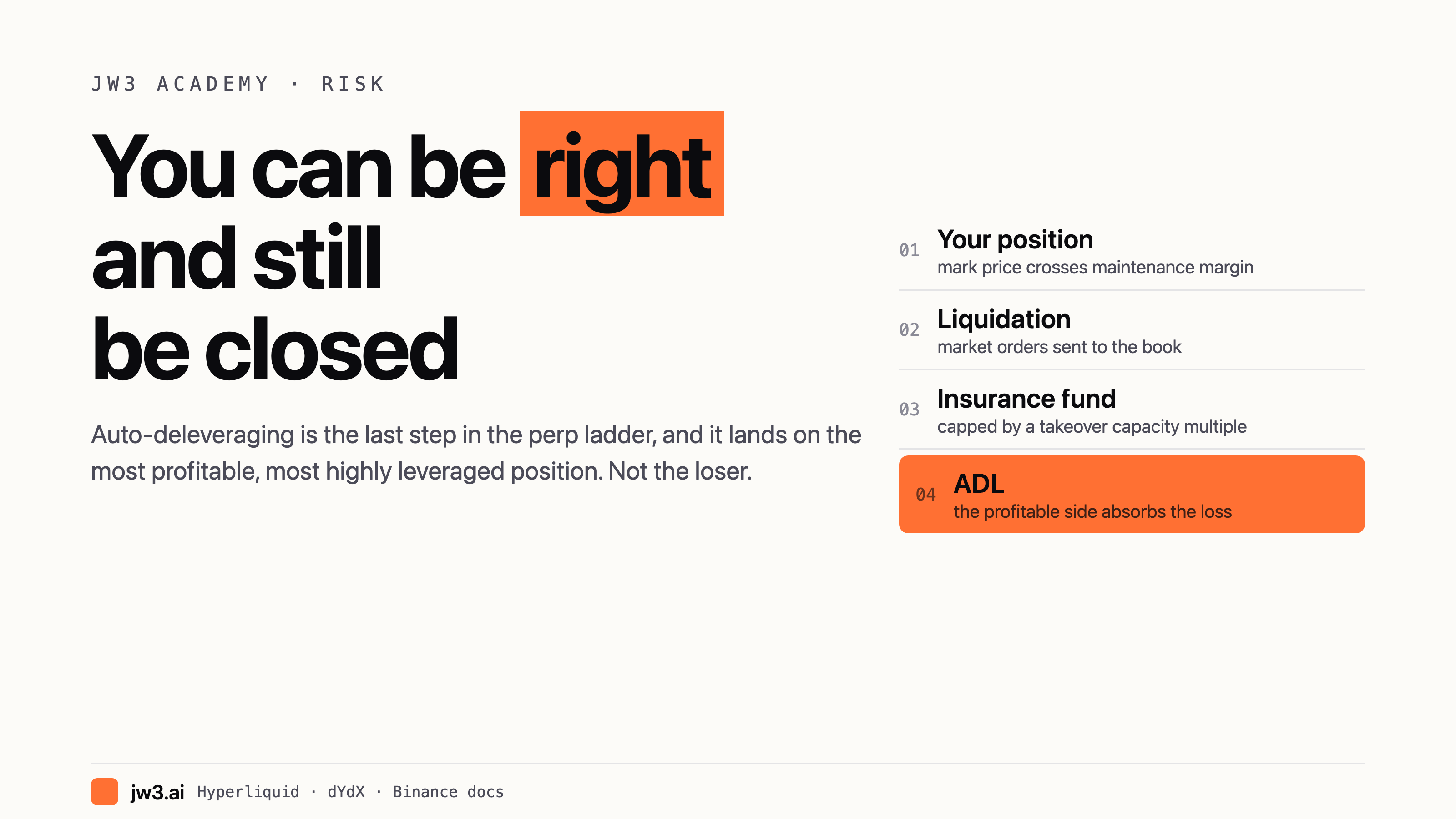
You can be right and still be closed
Every major perp venue runs an ADL step after liquidation and the insurance fund. Hyperliquid ranks you on (mark/entry) x (notional/account value). dYdX picks randomly. Being profitable does not protect you.
There is a step in perpetual futures that almost nobody plans for. It is not a liquidation. Your margin is still healthy, your position is not underwater against you, and the exchange is going to close it anyway.
That step is auto-deleveraging, ADL. It exists because a losing account can go negative before anyone can be liquidated, and a venue that lets a negative account stand has bad debt. ADL is the mechanism that makes the loss land on somebody else, and the design brief is explicit about who: the profitable ones.
Where ADL sits in the ladder
The order is consistent across venues, and the order is the whole point.
Position → liquidation → insurance fund or liquidator vault → ADL.
Hyperliquid documents its own version of that ladder in detail on its liquidations page, and it is more granular than a single "liquidation" step suggests. Account equity below the maintenance margin sends market orders to the book first. If equity drops below 2/3 of the maintenance margin and the book does not fill, backstop liquidation happens through the liquidator vault. Only a negative account value reaches ADL.
The margin numbers behind it are worth holding. Maintenance margin is half of initial margin at max leverage, which varies from 3x to 40x. So maintenance margin runs from 1.25% for 40x assets to 16.7% for 3x assets, depending on the asset. A 40x position is liquidated at a quarter of the distance a 3x position is.
There is a second consequence in the same paragraph. "During backstop liquidation, the maintenance margin is not returned to the user." The vault needs a buffer to stay profitable on average, and that buffer is your maintenance margin.
On cross positions, backstop liquidation transfers the trader's cross positions and cross margin to the liquidator — "if the trader has no isolated positions, the trader ends up with zero account equity." Isolated positions are contained: only that position and its isolated margin transfer.
On dYdX the insurance fund is described as the first backstop, and it is used "before any deleveraging occurs." If it is depleted, "positions with the highest profit and leverage may be used to offset negative-balance accounts."
The important detail from the same page: "once an account balance turns negative, deleveraging occurs immediately without using the insurance fund."
That sentence is the mechanism in miniature. The fund is a buffer that smooths small losses. It is not a guarantee. It runs out, and when it does, the ladder skips straight to your counterparty.
What actually triggers it
Hyperliquid's documentation states the trigger plainly: "If a user's account value or isolated position value becomes negative, the users on the opposite side of the position are ranked by unrealized pnl and leverage used."
Hyperliquid also publishes the ranking formula, which is unusual transparency:
(mark_price / entry_price) * (notional_position / account_value)
Two things are multiplied together. Profit ratio, and position size relative to your equity. A large position on the same account equity ranks you earlier.
There is one carve-out worth knowing: "Backstop liquidated positions have no special treatment in the ADL queue logic." Having just been liquidated through the backstop vault gives you no priority in the ADL queue. You are back in the same line as everyone else.
dYdX runs the selection differently, and the difference matters more than it might seem. Its documentation says deleveraging happens "against randomly chosen offsetting positions." Random, not ranked. On Binance and OKX it is explicitly ranked, and on both, more profitable and more highly leveraged positions are queued first.
So depending on the venue, you are either first in a queue you do not want to be in, or you are in a lottery. Neither is a protection.
Who gets hit, on each venue
| Venue | Selection | Execution price | |---|---|---| | Hyperliquid | Ranked: (mark/entry) × (notional/account value) | Previous mark price | | dYdX | Randomly chosen offsetting positions | Not stated in the doc | | Binance | Ranked: profitable and highly leveraged first | Bankrupt counterparty's Bankruptcy Price | | OKX | Ranked on leverage PnL% | Mark price normally, bankruptcy price if the fund is nearly depleted |
Two of those execution prices deserve emphasis.
On Binance, the profitable position is closed at the Bankruptcy Price of the liquidated order, and Binance warns that "The Bankruptcy Price may be out of the contract's market price range." You are not being closed at a market price. You are being closed at a computed offset point that may not be where the market trades.
On OKX, mark price applies normally, "However, if the applicable security fund is nearly depleted, the deleveraged positions could be closed at bankruptcy price."
Why profitable traders get chosen
The logic is not irrational. Someone has to absorb the loss, and the venues choose the party with the most capacity to take it.
But look at what that means from your side of the trade. On every venue, the ranking formula rewards profit and punishes low leverage. If you are running the same setup at 20x that you could run at 3x, you have moved yourself up the queue without changing your thesis. The trade did not get worse. Your position in the queue did.
Low leverage is the documented protection, and the venues say so themselves. OKX frames ADL as promoting fairness to lower-leverage users. dYdX's documented rule is that the most highly leveraged offsetting accounts are deleveraged first.
The cost is not a fee
It is worth being clear about what ADL does and does not charge.
On Binance, no trading fee is charged on the ADL'd position. It is not a penalty in that sense. The cost is the position itself, and the future upside you no longer capture. If the trade was going to work, you no longer find out.
There are also operational costs. Open orders are cancelled on Binance ADL — all of them in cross margin mode, or the same token's orders in isolated mode. So a plan resting on the book does not survive.
On Hyperliquid, backstop liquidation forfeits the maintenance margin entirely: "During backstop liquidation, the maintenance margin is not returned to the user."
What is not true about insurance funds
The word insurance implies a backstop you can rely on. Both venues disown the term.
Binance: "Notwithstanding the use of the term 'insurance', the Futures Insurance Funds are not insurance products, and Binance is not an insurer."
OKX: "The Security Fund is not an insurance policy... Users have no beneficial interest, ownership rights, legal claim, or ability to direct the use of any assets held within the Security Fund."
Binance also caps what the funds do. They are "not used to cover traders' losses. Its only purpose is to cover any difference between the bankruptcy price and the execution price of the liquidation order." And each fund has a Maximum Takeover Capacity, defined as a confidential multiple of its current balance.
That last detail is the one to sit with. Capacity, not balance. A fund can hold a large balance and still have limited ability to absorb a specific bankruptcy.
What you can actually control
Size the position so the queue is not your problem. This is the only real lever. The ranking formulas multiply by notional relative to account value, so the same trade at lower leverage ranks you lower.
A stop order is not an exit you can rely on. A stop works in an orderly market. ADL exists for the moment the market is not one.
Expect to be closed on the right side. If your thesis is correct and your position is closed by ADL anyway, that is the mechanism working as documented. It is not a malfunction to appeal.
Reduce open resting orders in a position you cannot afford to lose. On Binance they are cancelled on ADL regardless.
Check whether your margin is isolated or cross. Cross positions on Hyperliquid lose all cross margin on backstop liquidation; isolated positions lose only that position and its isolated margin.
The wider point
Perpetual futures documentation is unusually good at describing mechanics and unusually bad at stating who carries the tail risk. The mechanics are published, the formulas are published, the ordering is published. What is easy to miss is that the system is designed so that the most leveraged winner is the most natural counterparty for someone else's failure.
That is a design decision, not a bug. It is also a real cost of leverage, and it is the one that shows up on the good trades.
Risk note: cryptocurrency trading and leveraged perpetual futures carry significant risk of rapid and total financial loss. Never risk funds you cannot afford to lose completely. Auto-deleveraging can close a profitable position without warning and at a price outside the market range. Nothing in this article is investment advice, a recommendation, or an offer to sell any product.